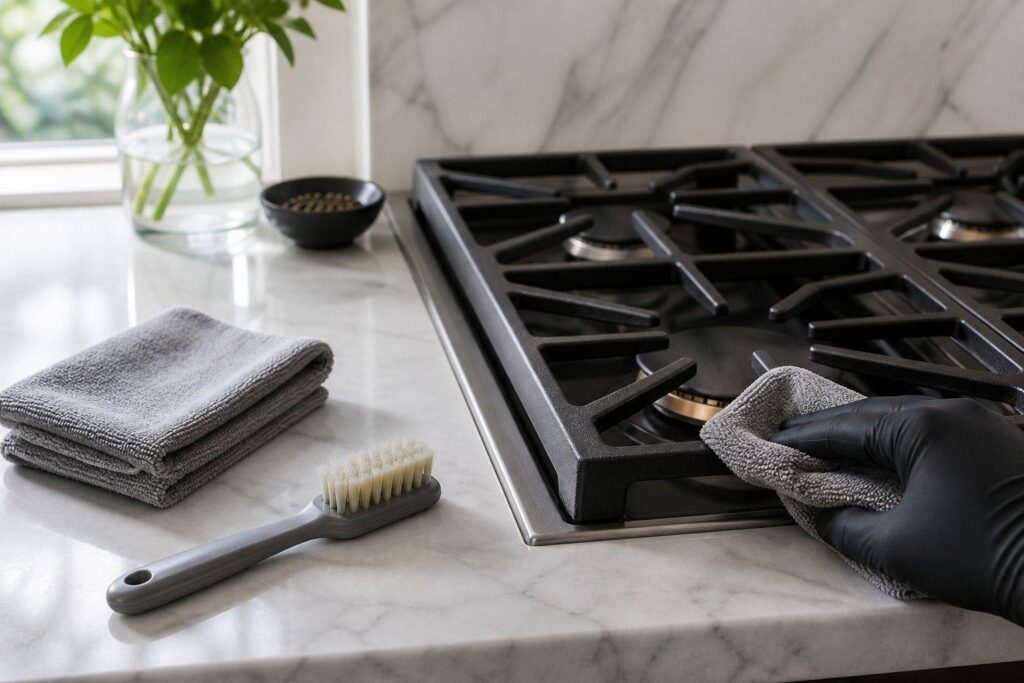
On the cooktop, wipe spills once the surface has cooled, and keep burner ports clear so the flame stays even. Confirm burner caps sit properly after any cleaning. The cooking tips for these ranges say caps must be locked in position for ignition, so a cap left crooked is a common-sense prevention check rather than a repair.
In the oven, keep foil off the floor and away from vents, and avoid forcing a door that resists. The CornuFe guide notes the oven door should not be left open longer than needed, because the knobs become very hot. Do not store items on the cooktop, since hot vent air from the oven may ignite flammables.
For the range itself, an anti-tip bracket must be installed and re-engaged if the range has been moved. The CornuFe guide also asks for a gap of at least 30 inches between the range top and any combustible surface above, and the hood collection calls for at least 24 inches from the hood bottom to the cooking surface. If cabinets or a shelf were added after installation, those clearances are worth rechecking.
| Area |
What prevention looks like |
Early warning that needs a visit |
| Hood filters and fan |
Cleaning on the interval the hood guide gives |
Rattling, new noise or suction that stays weak after the filters are clean |
| Ductwork |
Short, rigid metal runs with few elbows |
Weak extraction since installation, or exhaust that seems to run downward |
| Burners |
Clean caps, clear ports, caps locked in position |
Burner that clicks without lighting, or a long white-tipped flame |
| Oven |
Level range, intact door seal, nothing blocking vents |
Food that browns unevenly even after loading is corrected |
| Cooktop surface |
Wiping spills when cool |
Cracked glass on an induction surface, which calls for disconnecting power |