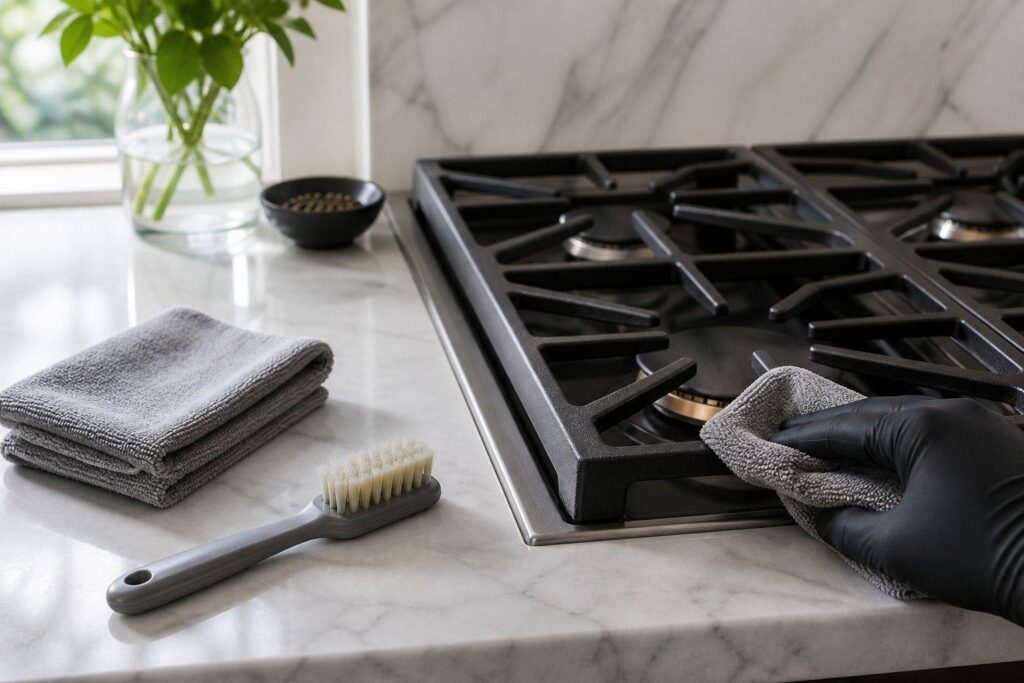
Wash gas burner caps in warm soapy water and make sure all the holes around each cap are clear of grease and debris. For solid-brass caps with burnt-on grease, the Chateau guide describes a soak in equal parts white distilled vinegar and water, boiled for 10 to 15 minutes, cooled before handling, rinsed and dried. After cleaning, the CornuFe guide says each burner head must sit correctly in its base and every part must be completely dry before it goes back.
The CornuFe guide says enamel burner grates and heads can go in the dishwasher. Let the range cool and switch off the circuit breaker before a thorough clean, and never mix cleaners or use paint solvents, caustic or chlorine-bleach products or coarse abrasives. On an induction surface, a glass cooktop cleaner is the guide’s choice, and a razor scraper may be used carefully around door gaskets with a plastic blade as the gentler alternative.
| Part |
What the manuals say to use |
What to avoid |
| Enamel panels |
Warm mild soapy water and a microfiber cloth, dried promptly |
Spraying cleaner directly onto the enamel |
| Oven interior |
Sponge and soapy water, or an enamel-safe degreaser left for 10 to 15 minutes |
Abrasive cleaners, which may compromise the enamel seal |
| Burner caps and heads |
Warm soapy water, clear holes, complete drying before reseating |
Reassembling damp parts or leaving ports blocked |
| Brass and copper trim |
Metal polish, microfiber, ammonia-free glass cleaner on hood trim |
Letting polish dry on the surface |
| Hood grease filters |
Dishwasher or hot detergent water, fully dried |
Reinstalling a wet filter, or letting grease build up on the fan |
Griddle surfaces have their own routine. For a teppanyaki top, the guide describes placing ice cubes on the hot surface after use, scraping grease into the channel and washing once cool with a non-abrasive sponge. A gas lava-rock grill is cleaned by running ventilation first, then burning off debris on high with a wire brush.